If you work in aged care, you understand how much trust older Australians place in your services. As the population continues to age, the demand for safe, reliable, and high-quality care at home keeps growing. At the same time, expectations and compliance requirements for aged care home providers are evolving.
A major shift is the introduction of the Support at Home (SAH) program, which launched in November. This program replaces both the Commonwealth Home Support Programme (CHSP) and Home Care Packages (HCP), with a stronger focus on person-centred, flexible, and safe in-home care.
For aged care providers operating under SAH, meeting the updated standards is now essential. That includes how you recruit, assess, and screen your workforce. Workforce screening isn’t just a compliance checkbox. It’s a key way to demonstrate that your team is safe, capable, and ready to deliver care with dignity and respect.
If you’re navigating how to become a home care provider for the elderly or adjusting to the new SAH requirements, understanding workforce screening is critical.
Let’s walk through what you need to know.
Understanding Aged Care Workforce Screening in Australia
When you’re caring for older people in their homes, trust is everything. Families and care recipients want to feel confident that the people supporting them are safe, respectful, and qualified. That’s where workforce screening comes in.
What is Workforce Screening?
Workforce screening is a legal process that checks a person’s background before they start working in aged care. It looks into their criminal record and any past misconduct. This applies to everyone on your team–paid workers, casual staff, and even volunteers.
The purpose is simple: to protect the health, safety, and dignity of older Australians. Whether you’re a small provider or part of a larger group, this step matters. It helps create a safer, more respectful care environment and shows you’re serious about quality.
What Does the Screening Involve?
There are two main types of checks involved:
- Police checks (also called police certificates): These look at a person’s national criminal history.
- NDIS Worker Screening Checks: These go deeper and are required in certain situations, especially if your staff support NDIS participants.
If you’re one of the Home Care Package providers preparing for the new Support at Home program, understanding which check applies and when is key. You want to make sure every staff member is cleared and compliant before they step into someone’s home.
Current Screening Options and Who Needs What
Workforce screening isn’t a one-size-fits-all process. For home aged care providers, understanding the right screening requirements is a critical first step, especially if you’re learning how to become a home care provider for the elderly. What your workforce needs depends on two key factors:
- Are you registered with the NDIS?
- Does the role involve NDIS participants or fall into a risk-assessed category?
Let’s break it down so it’s easy to follow.
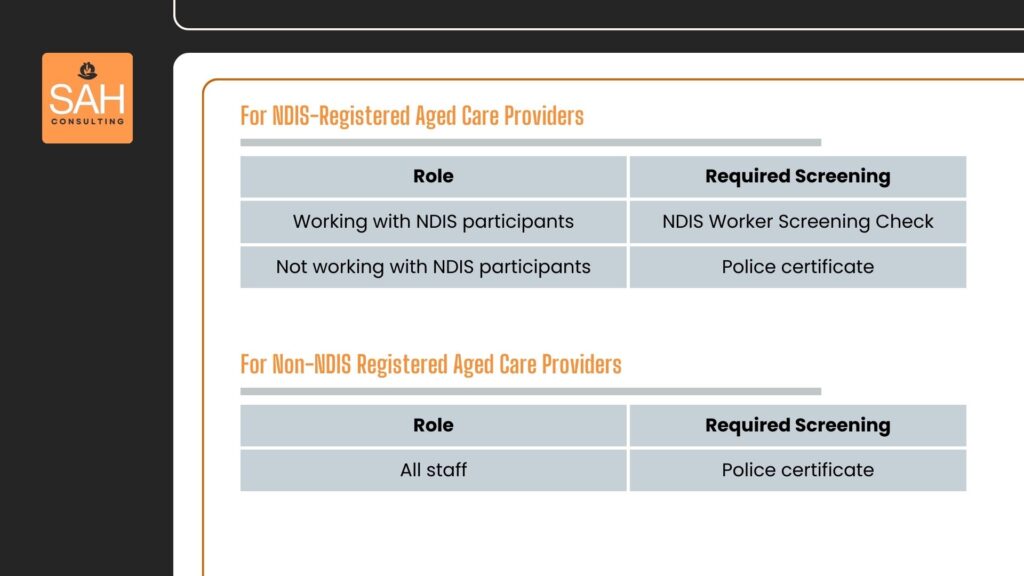
For NDIS-Registered Aged Care Providers
If you’re registered with the NDIS, your screening requirements will depend on whether your team works directly with NDIS participants.
| Role | Required Screening |
| Working with NDIS participants | NDIS Worker Screening Check |
| Not working with NDIS participants | Police certificate |
For Non-NDIS Registered Aged Care Providers
If you’re not registered with the NDIS, it’s easier:
| Role | Required Screening |
| All staff | Police certificate |
Already have an NDIS Worker Screening Check? Good news, you don’t need a separate police certificate. The NDIS check is accepted across both the aged care and disability sectors. That saves time and paperwork for you and your team.
Getting workforce screening right is a key part of meeting your compliance obligations. Whether you’re going through aged care provider registration or exploring how to become a home care provider for the elderly, you must be able to demonstrate that every member of your team holds the appropriate clearance before delivering care.
The New Aged Care Worker Screening Check
What Aged Care Providers Need to Know in 2026
The new national Aged Care Worker Screening Check is now being rolled out, bringing a consistent approach to workforce screening across all states and territories. For aged care home providers, this change simplifies requirements while strengthening safety and accountability across the sector.
Here’s what you need to know:
- A single national screening system
The new check replaces the previous mix of state-based police checks, creating a clearer and more consistent screening process for aged care workers. - Applies to risk-assessed roles
Workers will require this check if they:- Provide direct care to older people
- Hold leadership or governance roles, such as CEOs or Board Members
- Have more than incidental or casual contact with care recipients
- Transition arrangements are in place
Existing, valid police certificates remain acceptable until they expire. After that, workers in applicable roles must transition to the new screening check. - Clear guidance and lead time
The government has introduced transition pathways and guidance to help aged care providers move to the new system without disruption.
At SAH Consulting, we’re actively monitoring how this rollout affects providers on the ground. We’ll help you understand who needs the new check, when action is required, and how to stay compliant without unnecessary stress.
The NDIS Worker Screening Check – What It Is and When It Applies
You may already be familiar with the NDIS Worker Screening Check. While it sits primarily within the disability sector, it also applies to aged care workers in certain situations, particularly when they support NDIS participants as part of their role.
This screening check goes beyond a standard police certificate and includes:
- A review of the worker’s national criminal history
- Consideration of any reportable incidents, misconduct, or disciplinary actions
- A risk assessment to determine whether the individual is suitable to work with vulnerable people
Applications are processed through state or territory screening units on behalf of the NDIS Quality and Safeguards Commission.
Depending on the nature of the role:
- Some workers may also be required to hold a Working with Children Check
- In certain states or territories, workers may be allowed to start work while their application is being assessed, provided interim arrangements are permitted
Once approved, the worker’s clearance is recorded in the NDIS Worker Screening Database (NWSD). This allows providers to verify a worker’s screening status and ensure ongoing compliance.
SAH Consulting’s Role in Preparing Your Team
Preparing for Support at Home compliance can feel overwhelming, especially with new screening, governance, and registration requirements now in place. You don’t have to navigate it alone.
At SAH Consulting, we help aged care providers cut through the complexity and understand exactly what workforce screening and registration compliance mean in practice. No jargon. No guesswork. Just clear, practical guidance tailored to your services.
We support you by:
- Clarifying which workforce screening checks your team needs
- Ensuring your documentation is audit-ready and organised
- Aligning your systems with Support at Home registration requirements
- Helping you avoid common delays and compliance gaps
Whether you’re entering the sector for the first time or transitioning from CHSP or HCP, we guide you step by step so you can move forward with confidence.
To get you started, we offer a free consultation to assess your readiness, identify gaps, and map out the most efficient path to compliance.
Our Step-by-Step Registration Support
Becoming a registered Support at Home provider is a rigorous process. It’s designed to confirm that your organisation can deliver safe, high-quality care, not just on paper, but in practice. We help you turn this requirement into a strategic advantage.
Here’s how we support you:
- Free Initial Consultation – Assess your readiness, service scope, and registration category requirements.
- Key Personnel & Governance Review – Confirm leadership suitability, governance structures, and risk oversight.
- Policies & Compliance Setup – Develop or refine policies aligned with the Aged Care Act 2024 and Rules 2025.
- Application Preparation – Build a complete, well-structured application with the right evidence.
- Submission & ACQSC Support – Manage submission and respond to regulator feedback efficiently.
- Post-Registration Guidance – Support ongoing compliance and access to updated policies via the HCPA Portal.
- Business & Client Growth Support – Assist with planning and client acquisition strategies aligned to your services.
With SAH Consulting by your side, you stay focused on delivering safe, person-centred care, while we handle the compliance and registration complexities.
Key Takeaways for Aged Care Home Providers
Workforce screening isn’t optional. It’s a critical part of protecting older Australians and upholding the trust placed in aged care services. With the Support at Home program now in place, staying compliant is more than a regulatory requirement. It’s a clear signal of your commitment to safe, respectful, and high-quality care.
If you’re navigating how to become a home care provider for the elderly or need clarity around workforce screening and compliance, you don’t have to do it alone. At SAH Consulting, we remove the uncertainty so you can stay focused on what matters most, delivering great care.
Get in touch for a free consultation and take the next step towards compliance with confidence.