Thinking about expanding into home-based aged care services in 2026? You’re not alone. With major reforms now reshaping the sector under Australia’s new Support at Home Program, many providers are reassessing their service models and exploring how to start an aged care business in Australia under the updated regulatory framework.
The Support at Home Program forms part of the Federal Government’s broader aged care reform agenda, following the recommendations of the Royal Commission. The direction is clear: person-centred, flexible support that enables older Australians to remain independent, safe and respected in their own homes for longer.
As the program progressively replaces the Home Care Packages Program and the Commonwealth Home Support Programme, providers must prepare for a more streamlined funding model, clearer service pathways and strengthened compliance obligations. The landscape has shifted significantly. For providers entering or restructuring within the sector, understanding these changes early is essential to building a compliant, sustainable aged care business in Australia.
Understanding the Support at Home Program: Key Changes and Opportunities
What is the Support at Home Programme?
The Support at Home Program is Australia’s latest reform to in-home aged care. It aims to simplify how services are funded, delivered and managed for both older Australians and providers.
Under this model, the previous Home Care Packages Program and Commonwealth Home Support Programme are brought together into one streamlined system. This reduces duplication, creates clearer funding pathways and sets consistent expectations for providers.
For organisations exploring new aged care business ideas, the Support at Home Program creates a more structured and transparent environment to deliver services — but it also comes with clearer compliance and governance requirements that providers must understand from the outset.
What does the SAH Programme aim to do?
The goal is simple: help older Australians live safely and comfortably in their own homes for as long as possible. It’s about giving people real choice in how they get support, with care that fits their lifestyle, not the other way around.
If you’re planning how to start your own aged care business, these are the values that need to guide you:
- Ageing in place – The programme supports older people to stay in their homes, surrounded by the people and routines they love.
- Streamlined assessment and funding – One entry point, one assessment process. This makes it easier for clients to get the support they need quickly.
- Tailored services – Care plans are built around what matters most to the client. It’s about working with goals, not just ticking boxes.
Who Can Become a Provider?
If you’re serious about joining the sector, the good news is the door is open to both existing providers and new entrants. But you do need to meet the registration requirements set under the new Aged Care Act.
Here’s what you’ll need to get started:
- Registration as an approved provider – You’ll need to apply and show you can meet the standards expected under the SAH Programme.
- Specified services – When you register, you’ll need to outline which types of care you’ll deliver. These can include:
- Domestic assistance (cleaning, meal prep, etc.)
- Allied health services (like physio or podiatry)
- Personal care (showering, dressing, grooming)
- Transport and social support
This isn’t just a change in paperwork. It’s a fresh opportunity for you to build a meaningful, community-focused business. The SAH Programme offers a clear path for providers who want to make a difference and build a sustainable business while doing it.
How to Start an Aged Care Business in Australia
Before applying to deliver government-funded services, providers must ensure their business foundations are properly established. Entering the aged care sector requires more than clinical capability — it demands strong governance, financial planning and regulatory readiness.
At a minimum, you’ll need to:
- Register your business structure (company, partnership or sole trader) and obtain an ABN
- Establish appropriate insurance coverage, including professional indemnity and public liability
- Develop governance frameworks that outline decision-making, risk management and accountability
- Create operational systems, including policies for quality, complaints, incident management and workforce screening
- Plan workforce capability, ensuring staff meet qualification, screening and training requirements
Getting these fundamentals right reduces risk later, particularly when applying under the new Aged Care Act. A clear structure, documented systems and capable leadership will place your organisation in a far stronger position when progressing to formal provider registration.
Registering as a Provider Under the New Aged Care Act
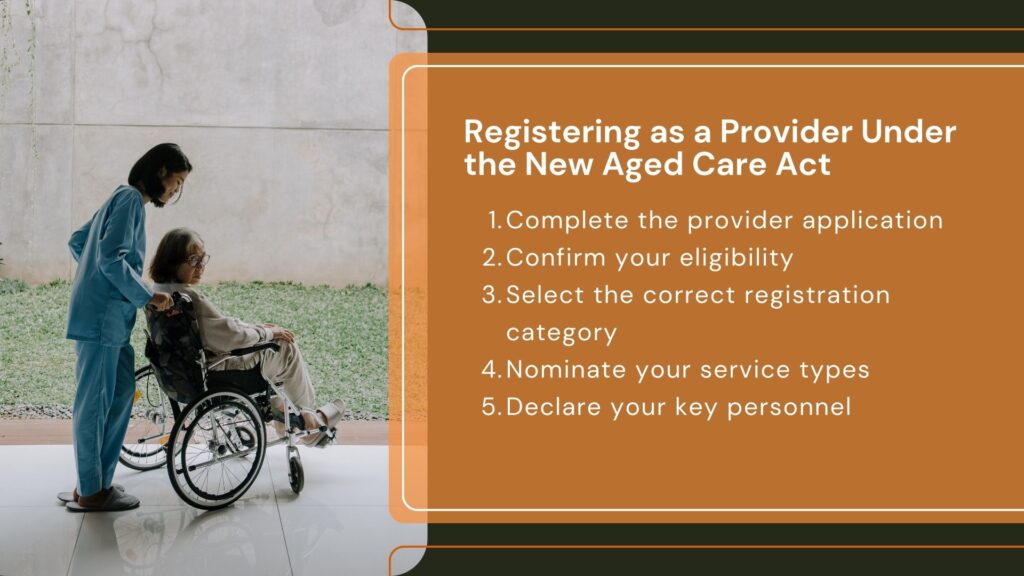
To deliver services under the Support at Home Program, you must register under the new Aged Care Act. The process is now more structured, with a stronger focus on safety, quality and accountability.
Here’s what you need to do:
- Complete the provider application – Submit your application through the Aged Care Provider Portal and provide all required documentation.
- Confirm your eligibility – Your business must be legally established in Australia, with appropriate insurance, governance arrangements and operational systems in place.
- Select the correct registration category – Choose a category that reflects the type and risk level of services you intend to deliver. Lower-risk services, such as domestic assistance or social support, sit in different categories to clinical or nursing services.
- Nominate your service types – Clearly outline the supports you will provide, such as personal care, allied health, transport, nursing or home assistance.
- Declare your key personnel – Identify the individuals responsible for managing and overseeing your organisation. These people must meet suitability requirements under the Act.
Careful preparation at this stage will make the assessment process smoother and reduce the risk of delays or requests for further information.
Understanding Provider Obligations
Once you’re registered, your job doesn’t stop there. You’ll need to meet ongoing obligations under the new Aged Care Act. These rules keep you on track and help make sure older Australians get the safe, respectful care they deserve. Here’s a breakdown of what you need to know.
a. Compliance Agreements
You might be asked to enter into a compliance agreement. These are “agreements to agree”—meaning you commit to doing something in future, like completing staff training or improving your governance systems. They help you stay on the right path without facing immediate penalties.
b. Enforceable Undertakings
These are formal promises to fix a problem, and you must follow through. If you’re asked to complete certain tasks by a deadline, you’ll need to stick to it. Keep clear records of what you’ve done—regulators will check.
c. Governance Responsibilities
You must meet strong governance standards, especially if you’re providing higher-risk services. That means clear leadership, good decision-making processes, and regular reporting. If you had an exemption under the old rules, you’ll need to review it—it may no longer apply.
d. Key Personnel Suitability
Everyone in a key role must pass the fit and proper person test. If someone doesn’t meet the requirements, they can’t stay in the role. It’s your job to make sure your leadership team is suitable and stays that way.
e. Regulatory Notices
You could receive compliance notices, non-compliance notices, or requests for more information. Respond to these quickly and clearly. Ignoring them can lead to bigger issues down the track.
f. Sanctions and Conditions on Registration
Under the new system, there are no more “places” or “extra service status”. Instead, regulators can apply new tools like banning orders, fines, or changes to your registration. These are serious, so make sure you stay compliant.
g. Suspensions and Revocations
If things go wrong, your registration can be suspended or revoked. The process must follow fair procedures and timelines, but it’s important to act fast and cooperate fully. Don’t let small problems turn into big ones.
Let SAH Consulting Support Your Registration
Becoming a registered provider under the new Aged Care Act is a rigorous process. It’s designed to ensure every organisation can demonstrate strong governance, financial stability and safe service delivery — not just submit paperwork.
At SAH Consulting, we help turn this complex requirement into a structured, manageable process. We guide providers through the Universal Provider Registration framework and help build compliant systems from the ground up.
We support you to:
- Understand the new regulatory requirements clearly and confidently
- Prepare a complete and well-documented application
- Develop compliant policies and procedures
- Strengthen governance and operational systems
- Minimise delays and respond to regulator queries effectively
With the right preparation, registration becomes more than a hurdle, it becomes the foundation of a sustainable, high-quality aged care service.
Building a Future-Proof Aged Care Business
The Support at Home Program marks a significant shift in how in-home care is delivered and regulated across Australia. Providers who prepare early, with strong governance, compliant systems and a clear service model, will be best positioned to succeed under the new framework.
Understanding how to start an aged care business in Australia now means understanding reform, registration and long-term sustainability. Quality, accountability and client-centred care are no longer differentiators — they are baseline expectations.
If you’re planning to enter the sector or expand your services, expert guidance can make the process smoother and more strategic. Contact SAH Consulting to ensure your organisation is prepared, compliant and ready to grow with confidence.