Australia’s aged care sector is undergoing a significant shift with the rollout of the Support at Home Program. At the centre of this reform is the integrated assessment tool, now the standard for determining client eligibility, funding levels, and service needs.
For providers, this marks more than a procedural change. Assessment outcomes will directly shape how services are delivered, funded, and monitored. This article offers practical guidance on how to prepare your organisation, not individual clients, for IAT-based assessments and the operational expectations that follow.
Understanding the Role of the IAT in the Support at Home Program
The IAT sits within the broader My Aged Care system, forming part of a more unified and consistent approach to aged care assistance across Australia.
Under this model:
- Assessments are conducted through a Single Assessment System
- Outcomes determine funding classifications (Levels 1–8)
- These classifications guide the scope and intensity of services that providers are expected to deliver
This shift replaces previously fragmented assessment processes with a more standardised framework. While this improves consistency, it also increases scrutiny. Providers are now expected to align closely with assessment outcomes, with less room for interpretation or variation.
What the IAT Actually Measures (And Why It Matters for Providers)
The integrated assessment tool evaluates multiple domains to build a structured profile of each client:
- Functional capacity, including activities of daily living
- Cognitive and mental health status
- Medical complexity and clinical needs
- Social and environmental factors
For providers, this means:
- Client profiles are more data-driven and consistent
- Service delivery must directly reflect assessed needs
- There is reduced flexibility in adjusting care outside defined parameters
In practice, this requires stronger alignment between assessment outcomes and how care is planned, documented, and delivered.
Operational Impacts: What Changes for Your Organisation
Service Design Must Align with Funding Classifications
IAT outcomes determine the level of funding a client receives and the type of services they are eligible for. Providers must ensure their service offerings match these classifications. Any mismatch between funded care and delivered services can create compliance risks.
Increased Documentation and Evidence Requirements
There is a greater emphasis on maintaining detailed and consistent client records. Documentation must clearly support care decisions and demonstrate alignment with assessment outcomes.
Workforce and Capability Planning
Staff across the organisation need to understand how assessment results translate into care delivery. This includes:
- Interpreting classification levels
- Developing care plans within funding constraints
- Ensuring administrative and coordination teams can manage assessment-driven workflows
Key Challenges Providers May Face with IAT Implementation
The transition to a standardised assessment model introduces several challenges:
Algorithm-driven outcomes can limit transparency, making it difficult to fully understand how classifications are determined. There is also a risk of under-assessment, where funding may not fully reflect a client’s real-world needs.
Flexibility is reduced. Adjusting services outside assigned funding levels becomes more difficult, requiring careful planning and justification.
Operational pressure may increase, particularly with faster turnaround expectations and the need to align quickly with standardised assessment outputs.
Potential Advantages of the IAT for Providers
Despite these challenges, the IAT also presents opportunities.
Greater consistency across assessments provides clearer benchmarks for service delivery. Structured data can support more targeted and effective care planning, improving outcomes for clients.
At a system level, standardisation makes it easier to align services with national expectations. For providers with strong governance and operational systems, this creates an opportunity to stand out in a more regulated environment.
How to Prepare Your Organisation for IAT-Based Assessments
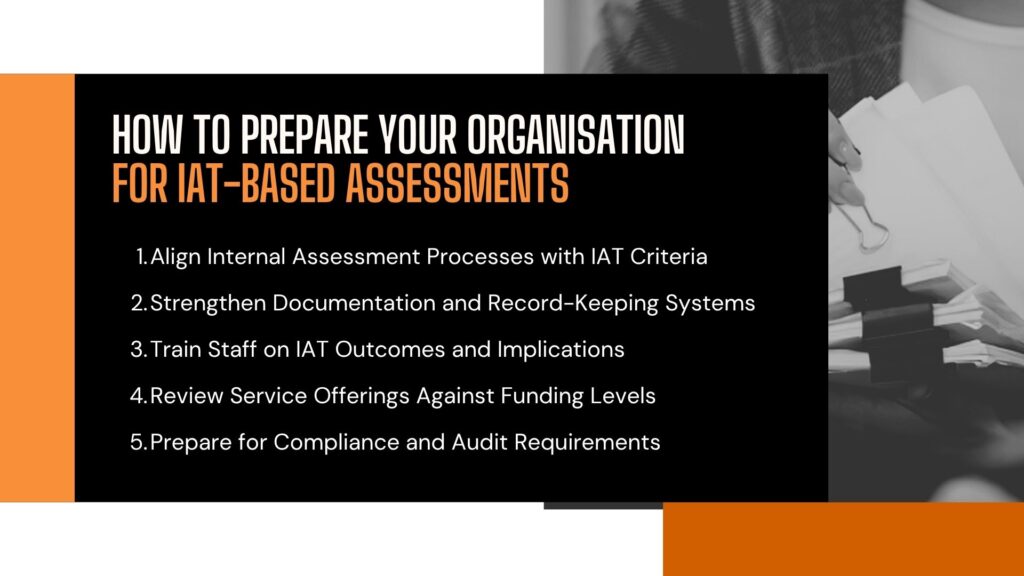
Preparation is critical. Providers that take a proactive approach will be better positioned to operate effectively under the new framework.
1. Align Internal Assessment Processes with IAT Criteria
Review your intake and assessment workflows to ensure they reflect national assessment domains. Consistency between internal processes and external assessments will reduce friction and improve care planning.
2. Strengthen Documentation and Record-Keeping Systems
Establish clear documentation standards across your organisation. Records should support care decisions, align with funding levels, and be audit-ready at all times.
3. Train Staff on IAT Outcomes and Implications
Ensure both clinical and administrative teams understand:
- How to interpret classification levels
- How funding translates into service delivery
- Their role in maintaining compliance under the new system
4. Review Service Offerings Against Funding Levels
Map your services to the classification tiers. Identify any gaps, overlaps, or inefficiencies that may affect your ability to deliver care within funding constraints.
5. Prepare for Compliance and Audit Requirements
Strengthen governance frameworks and review policies to ensure alignment with Support at Home expectations. Being audit-ready is no longer optional, it is a core operational requirement.
How SAH Consulting Can Support Your Organisation
At SAH Consulting, we go beyond basic compliance support. We work with aged care providers to build systems that are aligned with assessment-driven funding models and ready for real-world scrutiny.
We can help your organisation:
- Understand evolving regulations and requirements
- Simplify complex Support at Home and IAT frameworks
- Prepare a robust provider registration application
- Develop policies and procedures that support compliant service delivery
- Strengthen governance and operational readiness
- Identify and address gaps before they impact approval or performance
Our focus is on ensuring your organisation is not only compliant, but also operationally prepared to deliver care within the new system.
Conclusion: Turning IAT Readiness into a Strategic Advantage
The integrated assessment tool is not just a new assessment process; it fundamentally shapes how services are funded, delivered, and evaluated under the Support at Home Program.
Organisations that prepare early will be better equipped to operate efficiently, deliver care that aligns with assessed needs, and reduce compliance risk. In a more structured and transparent system, readiness is not optional; it is essential to long-term success.
If your organisation is preparing for the transition to IAT-based assessments, now is the time to act. SAH Consulting offers a free consultation to help you understand your current readiness, identify gaps, and map out a clear path to compliance.