The Support at Home Program may have officially launched, but the system is already showing signs of strain. What was intended to simplify and improve in-home aged care is, in practice, creating new layers of complexity for providers.
Recent developments highlighted in industry reporting point to growing concern. Federal politicians across party lines have called for urgent changes following a surge in complaints from both providers and participants. Issues around rising costs, flawed assessments, and access to essential services are quickly becoming central challenges.
This isn’t just policy noise; it’s an aged care reform update that is directly affecting how providers operate right now.
For many organisations, the reality is clear: delivering care has become harder, expectations are rising, and the margin for error is shrinking.
In this article, we break down why providers are struggling under the current system and what you should be doing to stay compliant, sustainable, and prepared.
What’s Driving the Surge in Complaints?
Understanding the current pressure points starts at ground level. While policy discussions highlight systemic issues, providers are the ones managing the real-world impact every day.
Here’s how the latest aged care legislation updates are translating into operational challenges.
Rising Costs Are Creating Friction With Clients
One of the most immediate issues is cost.
There are increasing reports of clients paying more while receiving less support. In some cases, essential services such as showering assistance are being charged at rates as high as $200.
For providers, this creates a difficult position.
You’re now expected to justify pricing decisions more than ever before. Clients and their families are questioning fees, comparing services, and becoming more sensitive to perceived value.
This shift introduces new risks:
- Higher levels of client dissatisfaction
- Increased likelihood of complaints
- Greater risk of client drop-offs
This is no longer just a financial issue, it’s a reputational one. Providers are now on the frontline of explaining system-driven costs that are often outside their control.
Essential Services Are Becoming Harder to Deliver
Concerns are also growing around access to basic daily care, including:
- Showering
- Dressing
- Meal preparation
These aren’t optional extras, they are core services that directly impact a client’s safety, independence, and wellbeing.
However, when affordability becomes a barrier, providers face a serious challenge. If clients reduce or decline these services due to cost:
- Care outcomes decline
- Health risks increase
- Providers may face scrutiny despite limited control over funding structures
This creates a disconnect between what providers know clients need and what the system allows them to deliver.
Assessment Outcomes Aren’t Matching Client Needs
Another major issue lies in how clients are being assessed. There are increasing reports of individuals with complex conditions, such as dementia or motor neurone disease, being reassessed at lower funding levels despite deteriorating health.
From an operational perspective, this creates immediate tension.
Providers may receive clients who:
- Have higher care needs than their funding allows
- Require services that exceed their allocated budget
The result?
- Service delivery becomes unsustainable
- Care may need to be adjusted or reduced
- Providers face difficult conversations with clients and families
This is not just a funding issue, it’s a service delivery risk that can directly impact compliance.
System Design Is Creating Pressure on Providers
When you zoom out, a pattern becomes clear. The challenges providers are facing aren’t isolated, they are built into how the system is currently functioning.
The “No Worse Off” Principle Is Being Questioned
The Support at Home Program was introduced with a clear promise: participants would be “no worse off.” However, this principle is now under scrutiny.
When clients feel they are paying more and receiving less, providers become the first point of contact for frustration and complaints, even when the issue stems from broader system design.
Pricing and Cost Structures Are Still Unclear
There is also ongoing uncertainty around pricing. Calls have been made for greater clarity on price caps and cost increases, with some reports suggesting service costs have risen by up to 40%.
For providers, this creates a moving target. You are expected to:
- Set fair and transparent pricing
- Remain competitive
- Stay compliant with evolving expectations
At the same time, the rules themselves are still shifting. This introduces significant risk:
- Misaligned pricing can lead to compliance exposure
- Lack of clarity can erode client trust
- Inconsistent structures can complicate internal processes
Capacity Pressure Is Increasing Across the System
Demand is rising rapidly. More than 230,000 older Australians are currently waiting for assessment or access to a package. At the same time, hospitals are experiencing delays due to the limited availability of aged care support.
For providers, this means:
- Longer waitlists
- Increased demand for services
- Pressure to deliver more with limited resources
The gap between demand and capacity is widening, and providers are being stretched to bridge it.
Why This Matters for Your Compliance and Registration
In a stable system, compliance can feel procedural. In the current environment, it has become critical.
System instability is driving:
- Greater scrutiny from regulators
- Higher expectations around documentation and justification
- Increased focus on how providers align services with funding
Providers must now ensure:
- Services are clearly aligned with approved funding levels
- Pricing is transparent, consistent, and defensible
- Care delivery reflects assessed needs and documented evidence
At SAH Consulting, we’re already seeing how these pressures are impacting provider applications and approvals.
Our team works closely with organisations to ensure every aspect of their registration, from governance structures to client-facing documentation, is aligned with ACQSC expectations and ready for assessment.
In today’s environment, compliance is no longer a checkbox exercise. It’s a core risk management tool.
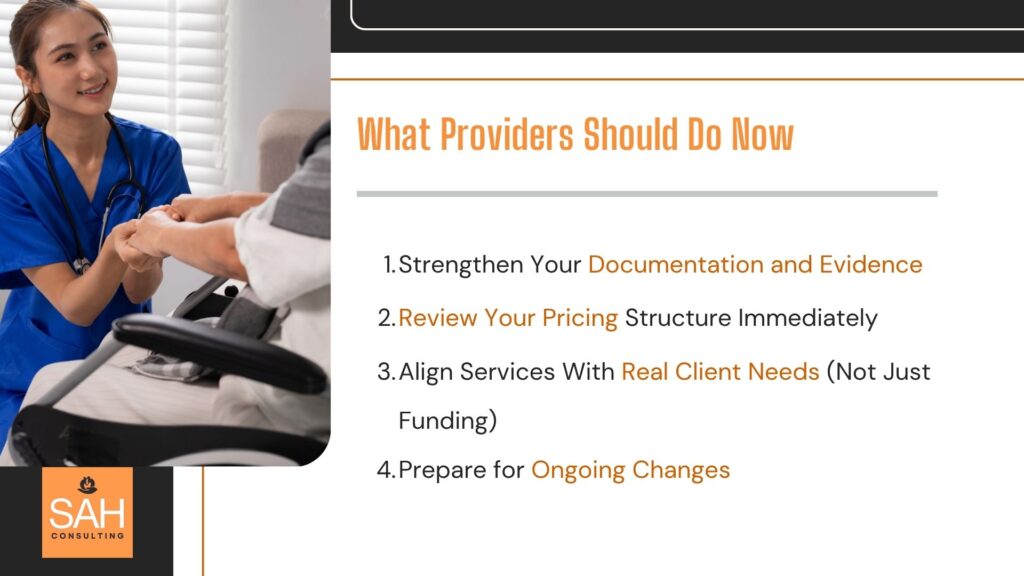
What Providers Should Do Now
While the system continues to evolve, there are clear steps providers can take to protect their operations and position themselves for success.
1. Strengthen Your Documentation and Evidence
Documentation is your first line of defence. Make sure:
- Care plans clearly justify service delivery
- Records align with funding classifications
- Decisions are supported by consistent documentation
You may need to defend your approach more frequently, whether during audits, assessments, or in response to complaints.
2. Review Your Pricing Structure Immediately
Now is the time to take a close look at your pricing. Ask yourself:
- Are your fees clearly explained to clients?
- Do they align with current expectations and guidance?
- Are they easy to justify if questioned?
Transparent and defensible pricing reduces the risk of complaints and prepares you for potential regulatory scrutiny.
3. Align Services With Real Client Needs (Not Just Funding)
Funding doesn’t always reflect reality. Providers should take a proactive approach:
- Identify gaps between allocated funding and actual care needs
- Support reassessments where necessary
- Escalate concerns when client safety or outcomes are at risk
Balancing compliance with quality care is essential, and requires active management.
4. Prepare for Ongoing Changes
The government has made it clear: reforms are still evolving. Providers should:
- Stay adaptable
- Regularly review internal processes
- Continuously update compliance frameworks
At SAH Consulting, we support providers through these changes by ensuring their systems, documentation, and applications remain aligned with the latest requirements.
Our approach is practical and tailored, we don’t just interpret the rules, we help you apply them effectively.
Final Thoughts
The recent surge in complaints isn’t just background noise, it’s a clear signal.
Providers are now navigating pricing pressure, ongoing assessment inconsistencies, and growing demand paired with limited capacity. This aged care reform update highlights a system that is still finding its footing, one that is placing increasing pressure on those delivering care on the ground.
Those who will succeed in this environment are the providers who prioritise compliance, maintain clarity in their processes and communication, and stay operationally ready as conditions continue to shift.
Need support navigating these changes? Our team at SAH Consulting works closely with providers to ensure their systems, documentation, and registration are fully aligned with current ACQSC expectations, so you can move forward with confidence.