
The rollout of the Support at Home Program introduced a major shift in how care needs are assessed. At the centre of this change is the Integrated Assessment Tool (IAT), an algorithm-driven system designed to determine eligibility and funding levels.
However, this system is now under growing scrutiny.
Recent reporting has highlighted concerns raised during a Senate inquiry, where serious questions were asked about how the tool is being used, and more importantly, its limitations. One of the most critical issues? Assessors currently cannot override the algorithm’s decisions, even when outcomes appear incorrect.
This isn’t just a technical or policy issue. It’s an aged care assessment challenge that directly affects your clients’ funding, the level of care they receive, and ultimately, their outcomes.
How the Algorithm Is Changing Aged Care Assessments
The introduction of the IAT marks a significant shift in how assessments are conducted. Under the current system, the tool determines:
- Eligibility for services
- Funding levels under the Support at Home Program
What makes this different is the level of standardisation.
Assessments are now driven by a fixed scoring system. Based on the inputs provided, the algorithm assigns a classification, without discretionary input from assessors.
In practical terms, this represents a move away from clinical judgement and towards a fully automated process. While the intention is to create consistency and objectivity, it also removes the flexibility that experienced assessors once had to account for complex or nuanced cases.
What the Senate Inquiry Has Revealed
The Senate inquiry has brought several important issues to light.
- First, there appears to be no clear legal basis preventing human override of the algorithm. Despite this, assessors are still unable to adjust outcomes, even when they believe the result does not reflect a client’s actual needs.
- Secondly, the tool was originally tested with human override in place. However, it was not tested in its current form, where that override has been removed.
This raises an important tension. The system has been designed to deliver consistent, “objective” outcomes. But in doing so, it may be overlooking the realities of clinical complexity. When assessors cannot intervene, even obvious discrepancies may go uncorrected.
The Real Impact on Clients (And Why Providers Should Be Concerned)
At a client level, the implications are significant. Evidence presented during the inquiry suggests that the algorithm may under-assess care needs. There are reported cases where individuals with serious or degenerative conditions are receiving lower funding levels despite worsening health.
Whistleblower concerns have also pointed to situations where clients are left without adequate care or financial support. From a support at home assessment perspective, this creates real challenges for providers.
You may find yourself supporting clients who:
- Are underfunded relative to their needs
- Require more care than their allocated package allows
This leads to:
- Gaps in service delivery
- Difficult decisions about care prioritisation
- Ethical and operational pressures on your team
The mismatch between assessed funding and actual need is no longer uncommon, and it directly impacts how you deliver care.
Rising Reviews Signal a System Under Strain
Another clear indicator of system pressure is the growing number of review requests.
Since the IAT launched, there have been 834 requests for internal review of assessment outcomes. Importantly, the review process is currently the only way to challenge an incorrect result.
However, reviews take more than two months on average. This creates a significant delay between identifying an issue and resolving it. For providers, this means managing:
- Clients who are waiting for appropriate funding
- Gaps in care during the interim
- Increased frustration from clients and families
The longer these delays persist, the greater the impact on both care outcomes and provider operations.
The Core Tension, Algorithm vs Clinical Judgement
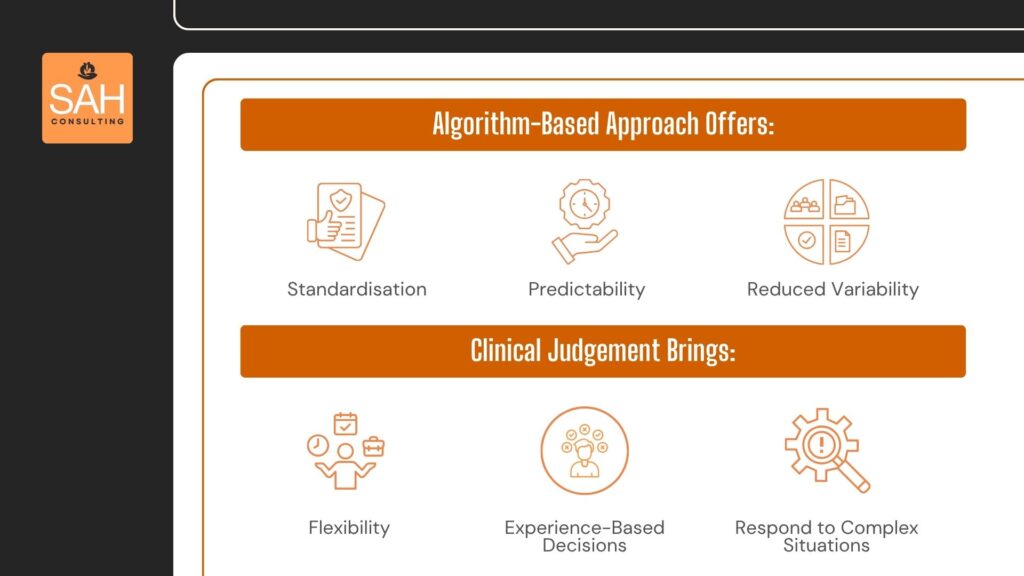
At the heart of this issue is a fundamental question: how do you balance consistency with accuracy? The algorithm-based approach offers:
- Standardisation
- Predictability
- Reduced variability in outcomes
But clinical judgement brings something equally important:
- Flexibility
- Experience-based decision-making
- The ability to respond to complex, real-world situations
During the inquiry, one question stood out: “Where is the human in all of this?” For providers, this question is critical.
Aged care is rarely straightforward. Clients present with layered needs, changing conditions, and unique circumstances that don’t always fit neatly into predefined scoring systems.
When the system prioritises consistency over context, the risk is that accuracy, and ultimately care quality, can suffer.
What This Means for Providers Right Now
While you can’t control how the algorithm operates, you can control how you respond to its outcomes.
In the current environment, providers should expect:
- A higher likelihood of misalignment between funding and care needs
- Increased responsibility to advocate on behalf of clients
- Greater reliance on reassessment and review processes
There are also rising expectations around documentation.
You will need to clearly demonstrate:
- The level of care required
- The gap between assessed funding and actual needs
- The rationale behind service delivery decisions
This isn’t optional, it’s becoming essential for both compliance and client outcomes.
What Providers Should Do Next
To navigate these challenges effectively, providers need to take a proactive approach.
-
Strengthen Assessment-Related Documentation
Ensure that all documentation clearly captures:
- Functional limitations
- Clinical needs
- Changes in condition over time
This information should align closely with assessment criteria to support accurate outcomes.
-
Be Proactive in Identifying Mismatches
Don’t wait for issues to escalate.
If funding does not reflect a client’s actual needs:
- Flag it early
- Document the gap clearly
- Take steps to address it
Support Clients Through Review Processes
Given that reviews are currently the only way to challenge assessment outcomes, providers play a key role in guiding clients through this process.
This includes:
- Helping gather supporting evidence
- Managing expectations around timelines
- Maintaining continuity of care where possible
3. Prepare for Possible Policy Changes
The government has already indicated it is seeking advice on reinstating human override. This suggests that further changes to assessment processes are likely. Providers should be ready to adapt to:
- Updates in assessment frameworks
- Shifts in compliance expectations
- Changes in documentation requirements
At SAH Consulting, we work closely with providers to ensure they are not only compliant with current ACQSC requirements but also prepared for what’s coming next.
Our team focuses on aligning your systems, documentation, and processes with real-world expectations, so you’re not caught off guard as the system evolves.
Final Thoughts: A System Still Finding Its Balance
The current assessment framework is still evolving. Right now, it relies heavily on automation, while concerns from policymakers, clinicians, and providers continue to grow.
This aged care assessment landscape presents both challenges and responsibilities. Until the system stabilises, providers must act as the bridge between algorithm-driven outcomes and real client needs.
At SAH Consulting, we support providers in navigating this complexity. From strengthening documentation to aligning your processes with assessment expectations, we help ensure you are fully prepared, both for compliance and for delivering the level of care your clients truly require.