Big changes have officially arrived for aged care providers. With the new Aged Care Act now in effect as of 1 November 2025, the sector is shifting its focus to the next major reform—the Support at Home Program. If you’ve been wondering what is the Support at Home Program 2025, it’s the government’s redesigned home care model replacing the Home Care Packages (HCP) and Short-Term Restorative Care (STRC) programmes. This change will significantly reshape how home care is delivered, funded, and managed across Australia.
The Commonwealth Home Support Programme (CHSP) will stay separate for now, but it’s expected to transition into the new system no earlier than July 2027. That gives providers some time to prepare.
Understanding these reforms is crucial. Providers need a clear view of how the changes affect funding, service delivery, reassessments, and their broader responsibilities in supporting older Australians. Preparing early means smoother operations, better client outcomes, and fewer surprises down the road.
Now’s the perfect time to understand the updates, review your internal systems, and make sure your team is ready for what’s next.
What’s Changing?
Automatic Transition: What Happens to Existing Clients?
The new Support at Home program will replace the Home Care Packages (HCP) and Short-Term Restorative Care (STRC) programs. Existing clients won’t need a reassessment, your transition happens automatically.
Here’s what to expect:
- Your funding level will match your current HCP level (or your approved level if you’re still waiting).
- Any unspent HCP funds will carry over into the new system.
- You can use these unspent funds for:
- Additional services if your quarterly budget runs out
- Approved assistive technology
- Approved home modifications
Key Program Changes That Affect Providers
The 2025 rollout brings several updates that aged care providers need to understand:
Quarterly Budgeting System
Annual package funds will now be distributed quarterly. That means each recipient gets four budgets per year, each covering three months. If part of the quarterly amount goes unused, up to $1,000 or 10% of the budget (whichever is higher) can be rolled over into the next quarter.
Service List Clarity
Support at Home will introduce a clearly defined list of services. Inclusions and exclusions will be standardised, removing ambiguity. For example, pet-related services will be excluded, but funding will remain for assistive dogs under separate arrangements.
Pricing and Administration
The old model of separate admin fees is being phased out. Instead, all pricing will be bundled into the cost of services. Also, 10% of each recipient’s quarterly budget will be allocated for care management support.
These changes aim to streamline processes, improve transparency, and reduce hidden costs—benefiting both providers and recipients.
New Classification System and Budgets
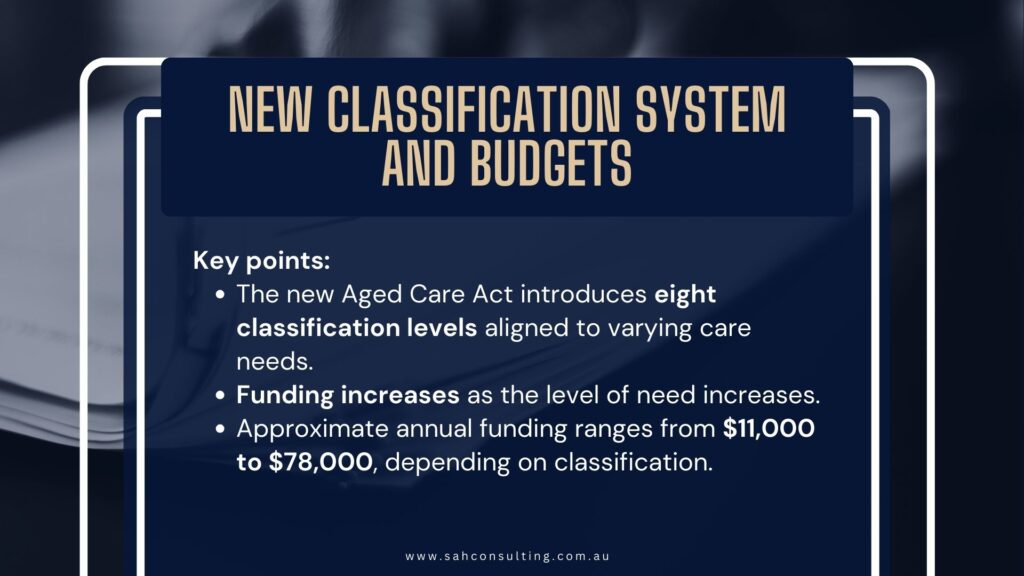
Under the Support at Home program 2025, funding is tied to eight ongoing classification levels based on each person’s assessed care needs. These levels determine how much support an older Australian receives to stay independent at home.
Key points:
- The new Aged Care Act introduces eight classification levels aligned to varying care needs.
- Funding increases as the level of need increases.
- Approximate annual funding ranges from $11,000 to $78,000, depending on classification.
This tiered system ensures each person receives funding that matches their individual support requirements.
Special Pathways
Restorative Care Pathway
- Funding: ~$6,000 over 12 weeks (may increase to ~$12,000 when eligible)
- Can be accessed in addition to an ongoing classification
- Designed for people who may benefit from short-term reablement and therapy
- After completion, a reassessment will determine the need for ongoing services
End-of-Life Pathway
- Funding: Up to ~$25,000 over a 12-week period (can extend to 16 weeks)
- For people with a prognosis of less than three months to live
- Provides support for people wishing to die with dignity at home
- Replaces the participant’s ongoing budget during this period
- Only accessible once in a participant’s lifetime
- If the participant’s health improves, they may transition to a suitable ongoing classification
Both pathways include access to assistive technology under the AT-HM Scheme. Importantly, services delivered under the Restorative Care Pathway must not duplicate those already accessed under an ongoing budget.
Assistive Technology and Home Modifications (AT-HM) Scheme
Under the Support at Home program 2025, funding for assistive technology and home modifications sits outside a person’s quarterly care budget. These amounts are approved during the assessment and tailored to the individual’s needs.
Before someone can access AT-HM funding, they must use any unspent Home Care Package (HCP) funds first. Most AT-HM funds don’t roll over from year to year, but there is one exception: funding for assistive dogs, which is reviewed and renewed annually.
Income-Related Contributions and “No Worse Off” Guarantees
The new aged care act includes protections to ensure people are not financially disadvantaged when they move into the new system. Current HCP recipients will keep their existing income-tested care fee arrangements.
The “no worse off” and grandfathering rules mean participants will keep the same contribution structure they had before. Even if someone is reassessed under the new program, they won’t pay more simply because their classification changes.
Reassessments: When and How They Work
According to the Support at Home transition Guide, clients won’t need a reassessment when the program begins on 1 November 2025. HCP recipients and people approved under the National Priority System will automatically shift to a Support at Home classification that matches their current or approved level.
Reassessments can still be requested if someone’s needs change. Clients can ask for one directly, or providers can help by arranging a Support Plan Review through My Aged Care. Any unspent HCP funds stay available after the transition and can continue to be used for approved services—they don’t expire and won’t be lost during reassessment.
Communication and Provider Roles During the Transition
To support a smooth rollout, the government is sharing clear information with older Australians, their families, and carers through education campaigns and newsletters such as the Department of Health and Aged Care’s EngAged updates.
Providers have an important role during this transition. They’re expected to guide clients, explain what the changes mean for their services and budgets, and help answer questions. Meanwhile, Services Australia will keep managing financial assessments so participants understand their income-based fees and obligations under the new system.
What’s Next? Manuals, CHSP Integration, and Provider Preparation
Now that the Support at Home program is underway, many providers are still asking what the Support at Home program 2025 is and how the new changes affect day-to-day operations. The official program manual is expected in early 2025 and will offer detailed operational guidance. Meanwhile, the Commonwealth Home Support Programme (CHSP) remains separate until at least 2027, with integration plans still developing.
It’s crucial for providers to begin aligning their internal systems, upskilling staff, and engaging with emerging guidelines and frameworks. Early preparation is key to ensuring continuity of care and regulatory compliance.
At SAH Consulting, we understand how overwhelming transitions like these can be. That’s why we offer tailored support to aged care providers navigating the move to Support at Home.
We help you simplify the change through:
- Compliance reviews to ensure readiness for the new requirements
- Staff training tailored to the latest program developments
- System and process preparation aligned with upcoming operational manuals
Whether you’re updating internal policies or planning full-scale organisational change, our experienced consultants are here to guide you every step of the way—so you stay ahead, not behind.
Final Thoughts
If you’re still working through what the Support at Home program 2025 is and how it affects your organisation, start by reviewing your budgeting processes, updating your service delivery model, and making sure your team understands the new requirements.
It’s also a good time to engage your clients. Clear, early conversations about the changes can help manage expectations and build confidence during this transition period.
If you need support, partner with SAH Consulting.
We provide tailored guidance, operational readiness reviews, and practical advice to ensure your organisation stays compliant, prepared, and well-equipped for what’s ahead.