The aged care sector is preparing for one of the most significant funding changes under the Support at Home program. From 1 October 2026, personal care services will officially move from the Independence Services contribution category to the Clinical Supports contribution category, aligning with the broader reforms introduced under the Australian National Aged Care Classification Framework.
For older Australians, this is a positive change. Approved personal care services will become fully government funded, removing out-of-pocket contributions for essential daily support such as showering, dressing and medication assistance, provided participants have available funds within their Support at Home budget.
For providers, however, the transition requires far more than a simple billing update. Existing service agreements, ICT systems, participant budgets, invoicing processes and client communications all need to reflect the new contribution arrangements by the October deadline. Preparing early will help you maintain compliance, minimise disruption and continue delivering a seamless participant experience.
Side-by-Side Comparison: Personal Care Billing Before and After 1 October 2026
The core change is straightforward: personal care is moving into a fully government-funded contribution category. However, providers need a clear understanding of how participant contributions will change and when the new rules apply.
| Current Arrangement (Before 1 October 2026) | New Arrangement (From 1 October 2026) |
| Personal care sits under the Independence Services contribution category. | Personal care moves to the Clinical Supports contribution category. |
| Participants pay a means-tested contribution, generally ranging from 5% to 50%, depending on their financial circumstances. | Participant contribution reduces to 0% for approved personal care services. |
| Providers invoice participants according to their applicable contribution rate. | The Australian Government fully funds approved personal care services where participants have available Support at Home funding. |
| Personal care contributes towards participant out-of-pocket expenses. | Participants no longer pay for approved personal care services delivered from 1 October 2026. |
One important detail remains unchanged. Any personal care delivered before 1 October 2026 must still be billed under the existing contribution rules, even if the claim or invoice is processed after the implementation date. Providers will need clear billing controls to ensure services are charged according to the correct funding period.
What Counts as Personal Care?
Although the funding model is changing, the definition of personal care is not. The scope of eligible services remains exactly the same, meaning providers should continue classifying services according to the existing Support at Home service list.
Fully Funded Services ($0 Participant Contribution)
From 1 October 2026, the following approved personal care services will attract no participant contribution:
- Showering, bathing and oral hygiene
- Dressing and undressing
- Non-clinical continence management and toileting assistance
- Assistance with eating and hydration
- Assistance with self-administration of medication
The reclassification affects participant contributions only. Workforce requirements, service delivery expectations, qualifications, registration categories and service identifiers all remain unchanged.
What Is Not Changing?
While personal care becomes fully funded, many other Support at Home services continue under their existing contribution arrangements.
Here’s a tighter version that scans better while using bullet points to emphasise the key takeaways.
1. Everyday Living and Independence Services Still Require Contributions
While personal care will become fully government funded, the October 2026 reform does not remove participant contributions for other Support at Home services.
The following services will continue to attract the applicable means-tested participant contribution:
- Everyday Living Services, including cleaning, gardening and meal preparation.
- Independence Services, such as transport, social support and other eligible assistance that falls outside the personal care category.
Eligibility requirements also remain unchanged. Participants must still:
- be assessed and approved for personal care services
- have available Support at Home funding
- receive services that fall within the approved personal care service type.
2. The Commonwealth Home Support Programme (CHSP) Is Unaffected
The October 2026 reform applies only to the Support at Home program. The Commonwealth Home Support Programme (CHSP) is expected to transition at the earliest in July 2027, meaning its funding arrangements remain unchanged.
It’s equally important to understand what this reform does not change. Providers should note that:
- workforce roles and qualifications remain the same
- service delivery models do not change
- service IDs remain unchanged
- registration categories and provider obligations stay the same
- this update relates only to participant contribution categories, not broader independent clinical services or operational requirements.
This version is more skimmable for busy providers while clearly separating funding changes from the operational elements that remain unchanged.
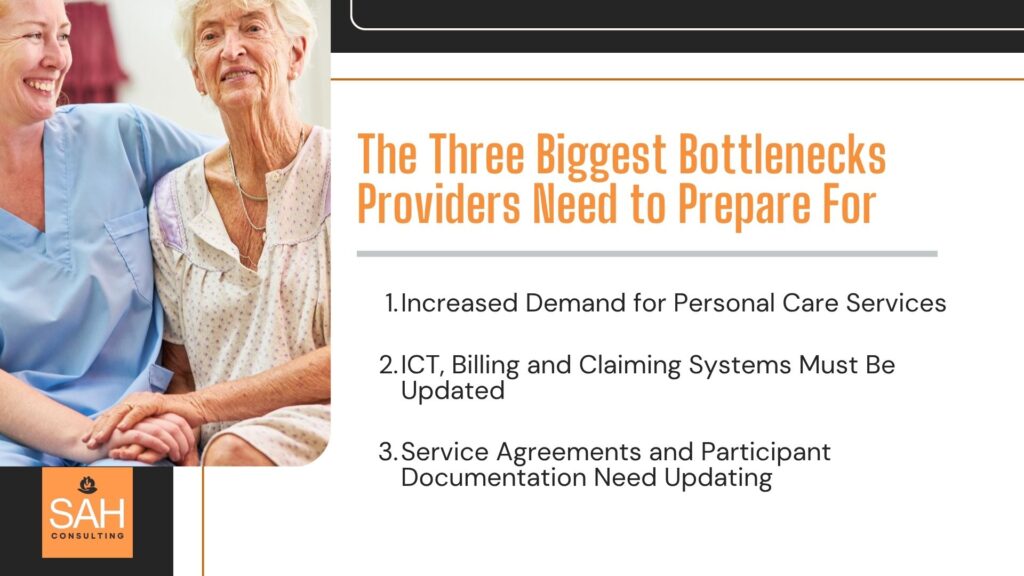
The Three Biggest Bottlenecks Providers Need to Prepare For
Although the policy change benefits participants, implementation will require careful planning across your organisation.
1. Increased Demand for Personal Care Services
Removing participant contributions is likely to encourage more clients to access additional personal care hours.
Many participants who previously limited services because of cost may request care plan reviews or adjustments to maximise their available Support at Home budget. Providers should anticipate an increase in care planning conversations, budget revisions and scheduling requirements in the months leading up to and immediately following implementation.
Planning workforce capacity early will help maintain service continuity as demand grows.
2. ICT, Billing and Claiming Systems Must Be Updated
For many providers, this will be the most significant operational challenge.
Billing platforms, CRM systems, participant statements, budgeting tools and claiming processes must all correctly recognise the new contribution category from 1 October 2026.
Particular attention should be given to services delivered before the implementation date but invoiced afterwards. These services must continue to apply the previous participant contribution rules. Incorrect billing, even if unintentional, could create compliance issues during future audits by the Aged Care Quality and Safety Commission.
Reviewing your software configuration, internal workflows and quality assurance processes well before the deadline will reduce the risk of costly errors.
3. Service Agreements and Participant Documentation Need Updating
The contribution change affects more than invoices.
Providers should review participant service agreements, individualised budgets, care plans, participant information packs, website content and staff guidance materials to ensure they accurately reflect the new funding arrangements.
Where contribution rates are referenced within agreements or attached budgets, updated documentation should be provided as soon as practicable. Care plans may also need revision if participants choose to increase their personal care services once out-of-pocket costs are removed.
A coordinated documentation review helps maintain consistency across your organisation while ensuring participants receive accurate information throughout the transition.
Prepare Now for a Smooth October Transition
The move to fully funded personal care represents an important step forward for participants, but it also creates a firm compliance deadline for providers. Accurate billing, updated documentation and well-prepared internal systems will be essential to maintaining compliance while delivering a positive participant experience.
As the Australian National Aged Care Classification reforms continue to reshape the sector, proactive preparation will place your organisation in the strongest position to navigate future regulatory changes with confidence.
If you’re preparing for the October 2026 transition, SAH Consulting can help you review your policies, service agreements, billing processes and operational documentation to ensure your organisation is compliant, assessment-ready and prepared for implementation. Contact our team today for a free consultation and let’s discuss how we can support your transition under the latest Support at Home reforms.