Delivering aged care in rural and remote areas has never been simple. Long travel distances, smaller populations and higher operating costs can make it difficult for providers to deliver consistent, high-quality services while remaining financially sustainable.
On 3 July 2026, the Australian Government announced more than $311 million for Round 3 of the Support at Home Thin Markets Grants. The funding aims to help eligible providers continue delivering essential services where access remains limited. While not every provider will qualify, the grants show the Government’s ongoing commitment to making aged care more accessible and equitable across Australia.
If you provide services in rural, remote or specialised settings, or you’re planning to expand into these communities, it’s worth understanding what this funding could mean for your organisation.
What Are Thin Markets in Aged Care?
A thin market exists when the demand for aged care services outweighs the number of providers that can realistically deliver them. In many cases, providers want to offer services, but the cost of doing so makes it difficult to operate sustainably.
Thin markets often develop because providers face challenges such as:
- Long travel times between clients
- Smaller client numbers across large geographic areas
- Higher staffing and recruitment costs
- Limited local workforce availability
- Increased operational expenses
These challenges can make it harder for providers to deliver timely and affordable care under the Support at Home program.
Thin markets are not limited to geography. They can also affect providers delivering specialist services where demand exists, but only a small number of organisations have the skills, workforce or experience to meet those needs.
Examples include:
- Rural communities
- Remote communities
- Aboriginal and Torres Strait Islander communities
- Culturally and linguistically diverse communities
- Other specialised groups where provider availability remains limited
Understanding these challenges helps explain why the Government continues investing in aged care in rural and remote areas through targeted funding initiatives.
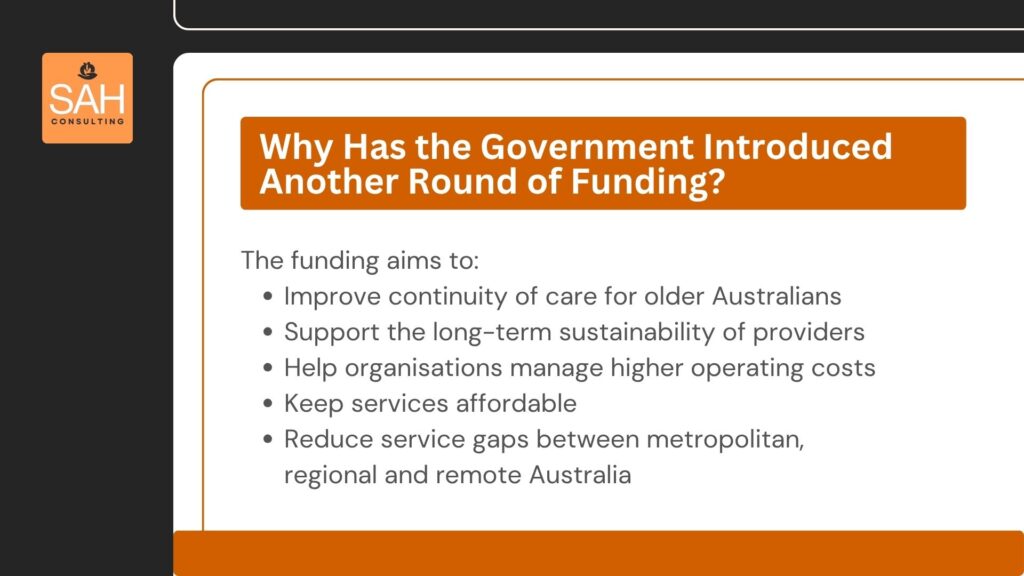
Why Has the Government Introduced Another Round of Funding?
Round 3 of the Support at Home Thin Markets Grants builds on previous funding rounds that helped providers continue delivering services in locations and communities where operating costs remain high.
The funding aims to:
- Improve continuity of care for older Australians
- Support the long-term sustainability of providers
- Help organisations manage higher operating costs
- Keep services affordable
- Reduce service gaps between metropolitan, regional and remote Australia
More than $311 million will be available during the 2026 to 2027 financial year through a flexible funding model that allows eligible providers to use the funding where it will have the greatest impact.
Providers that received funding in previous rounds may also apply again if they continue to meet the eligibility requirements.
The announcement also recognises something many providers already know. The aged care impacts in rural city settings can differ greatly from those in metropolitan areas. Workforce shortages, travel demands and service availability often require different funding approaches to support ongoing care.
Which Providers May Be Eligible?
1. Rural, Remote and Specialised Services
The funding focuses on providers delivering services in locations where maintaining service availability can be more challenging.
Eligible organisations may include providers delivering services in Modified Monash Model (MM) Areas 3 to 7, as well as providers offering specialised services anywhere in Australia where demand remains high but provider numbers remain low.
The grants provide flexible funding that can help providers strengthen rural aged care services, improve workforce capacity, and support the additional costs involved in delivering care across large geographic areas.
As with previous funding rounds, providers should carefully review the eligibility criteria before applying.
2. Aboriginal and Torres Strait Islander Services
The Government has also included a dedicated funding stream for providers supporting Aboriginal and Torres Strait Islander communities. These services play an important role in delivering culturally safe and appropriate care while helping older people remain connected to their families, communities and culture.
Depending on the funding stream, you may need Specialisation Verification as part of your application. Preparing this documentation early can help avoid unnecessary delays once applications open.
Why This Matters Beyond Rural Providers
Even if your organisation does not qualify for Thin Markets funding, this announcement still provides valuable insight into the direction of aged care reform.
The Government continues to prioritise:
- Equitable access to services
- Financial sustainability for providers
- Recognition of higher service delivery costs
- Stronger workforce capability
- Continued support for specialised providers
These priorities reach well beyond rural funding. They reflect the broader goals of the Support at Home program and highlight where future investment may continue.
For providers across the sector, this creates an opportunity to review service delivery, workforce planning and long-term business sustainability. Understanding these priorities now can help you prepare for future funding opportunities and changing compliance expectations.
How Providers Can Prepare
Although applications may not open immediately, preparing early can place your organisation in a stronger position.
Consider taking these steps:
- Confirm your Modified Monash Model (MM) classification.
- Review the latest eligibility requirements.
- Check whether Specialisation Verification applies to your organisation.
- Gather supporting documents before applications open.
- Review previous grant rounds to understand eligibility and funding requirements.
- Monitor GrantConnect and Department of Health updates for application dates.
- Consider how funding could strengthen your workforce, cover travel costs and improve service continuity.
Planning ahead can make the application process smoother and help you identify where funding could support your organisation’s long-term goals.
Final Thoughts
The Support at Home Thin Markets Grants offer more than financial assistance. They form part of the Government’s broader strategy to keep aged care in rural and remote areas accessible, sustainable and equitable while supporting providers facing higher delivery costs.
Whether your organisation operates in rural communities, delivers specialised services or plans to expand into underserved areas, now is the time to review your eligibility and prepare for future funding opportunities.
At SAH Consulting, we work with aged care providers to understand Support at Home requirements, strengthen compliance and prepare for funding opportunities with confidence. If you’re planning your next steps, we’re here to help you build a sustainable service that supports your community for years to come.