From 1 October 2026, an important funding change under the Support at Home Program will affect how you manage personal care services. While the way you deliver care will remain the same, the way you administer participant contributions will not.
For many providers, this means reviewing ICT systems, billing processes, participant documentation and every care plan in aged care that may be affected by the change. Preparing early will help you minimise disruption, reduce administrative errors and maintain compliance when the new arrangements take effect.
This guide explains what is changing, what stays the same, and the practical steps you should take to prepare your organisation before 1 October.
What Is Changing on 1 October 2026?
From 1 October 2026, all eligible personal care services under the Support at Home service list will move from the Independence contribution category to the Clinical Supports contribution category for participant contributions.
As a result, the Australian Government will fully fund eligible personal care services. Participants will no longer pay contributions for these services, provided they:
- are approved to receive personal care services in their support plan
- have available Support at Home funding.
Although participants will no longer contribute towards eligible personal care services, those services will still be funded through their available Support at Home budget.
The change aims to improve access to essential personal care by removing out-of-pocket costs for eligible participants.
What Isn’t Changing
While the funding arrangements are changing, several key aspects of service delivery remain the same.
The following will not change:
- the definition and scope of personal care services
- eligibility and assessment requirements
- service IDs
- workforce roles and qualifications
- provider obligations for claiming, billing, record keeping and service delivery.
It’s also important to remember that personal care services delivered before 1 October 2026 will continue to attract participant contributions under the current arrangements, even if you submit the claim after 1 October.
Why Providers Should Start Preparing Now
Although the change centres on participant contributions, its impact extends well beyond finance.
Your organisation may need to update multiple operational areas, including:
- ICT systems
- billing and invoicing
- participant statements
- service agreements
- budgets
- care documentation.
The sooner you begin reviewing your systems and processes, the more time you’ll have to identify gaps, test changes and train your team before implementation.
A structured approach also reduces the risk of billing errors, participant confusion and compliance issues during the transition.
Review Your ICT Systems
Your ICT platform sits at the centre of day-to-day operations, making it one of the first areas to review.
1. Update Contribution Settings
Check that personal care services are correctly mapped to the new participant contribution category. If your software automatically applies participant contributions, review those rules carefully to ensure they align with the new funding arrangements from 1 October.
2. Review Software Integrations
If you use third-party software for rostering, finance, billing or client management, speak with your software vendor about their implementation timeline.
Confirm:
- when updates will be available
- whether configuration changes are required
- what testing should occur before the changes go live.
Testing your systems before implementation can help prevent costly errors after the transition.
3. Check Reporting Functions
Review how your software generates participant statements, financial reports and management reporting. These reports should accurately reflect the removal of participant contributions for eligible personal care services delivered from 1 October onwards.
Update Billing and Financial Processes
Billing workflows will need careful attention to ensure participant contributions are applied correctly before and after the transition date.
1. Review Invoicing Procedures
Personal care services delivered from 1 October 2026 should no longer include participant contributions. However, services delivered before that date must continue to follow the existing contribution arrangements, even if invoices or claims are processed later.
Review your billing procedures carefully so your finance team applies the correct rules based on the service delivery date.
2. Update Participant Budgets and Statements
Participant budgets and financial statements should accurately reflect the removal of personal care contributions while continuing to show how services are funded through available Support at Home budgets.
This is also a good opportunity to review how you communicate financial information so participants understand the changes.
3. Review Internal Finance Processes
Take time to assess your internal workflows for:
- billing
- claiming
- reconciliation
- financial reporting.
Clear processes reduce the likelihood of errors and help your team transition smoothly once the new arrangements begin.
As part of your broader aged care bill compliance processes, it’s worth reviewing internal controls to ensure billing practices remain consistent with the updated funding requirements.
Review Care Plans and Participant Documentation
Some participants may decide to increase their use of personal care services once participant contributions are removed.
That means your care coordination processes should be ready to respond.
1. Identify Participants Who May Benefit
Review participants who may have previously limited their use of personal care because of contribution costs. Where appropriate, discuss whether additional services would better support their goals while remaining within approved funding.
2. Update Care Plans Where Needed
Review each care plan in aged care where changes to service delivery may be appropriate. If participants request additional personal care, ensure their support continues to align with their approved services, available funding and assessment outcomes.
Strong aged care plan management helps your organisation maintain accurate documentation while supporting quality service delivery.
3. Review Participant Information
Update your participant-facing materials before the changes take effect.
This may include:
- information packs
- FAQs
- welcome documents
- service agreements
- website content.
Providing consistent information across all communication channels helps participants understand what is changing and what remains the same. It also ensures your aged care plans and supporting documentation continue to reflect current funding arrangements.
Keep Your Team and Participants Informed
Technology updates alone won’t ensure a smooth transition. Your people also need to understand the changes.
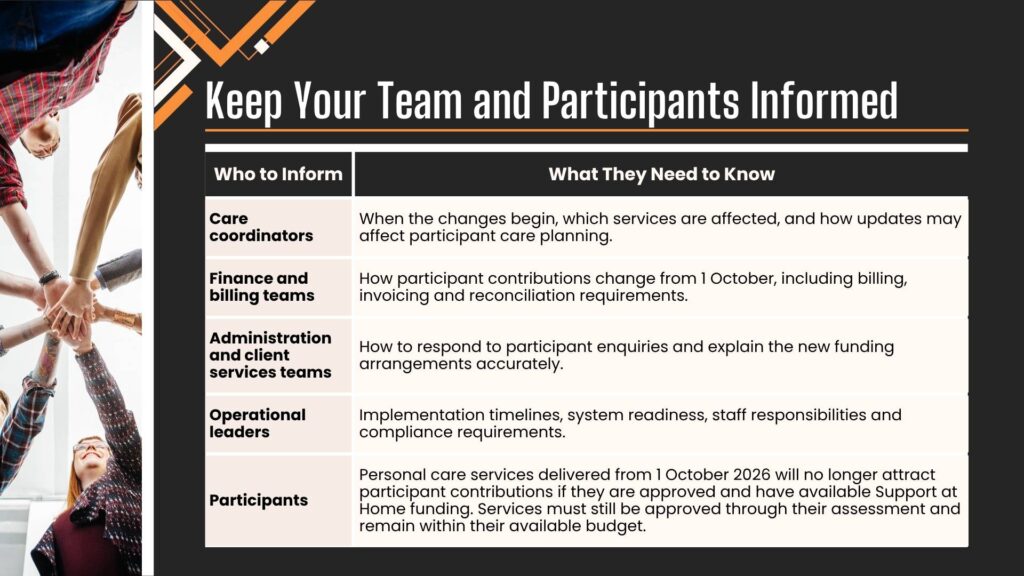
Clear, consistent communication helps build confidence across your organisation and reduces confusion as the new arrangements take effect.
Use the Available Readiness Resources
The Australian Government has published several resources to help providers prepare for the transition.
These include the Provider Readiness Checklist, which outlines practical actions across two implementation phases.
Phase 1 focuses on organisational readiness, ICT, stakeholder engagement and participant communication before 1 October.
Phase 2 covers implementation activities, issue resolution and ongoing monitoring once the changes take effect.
Alongside these resources, consider:
- attending provider information sessions
- joining the Support at Home Community of Practice
- subscribing to Support at Home updates
- working closely with your ICT vendors and internal implementation teams.
Using these resources together can help you identify risks early and coordinate changes across your organisation.
Partner with SAH Consulting for a Smooth Transition
Preparing for regulatory change involves more than updating software. You also need confidence that your governance, documentation and operational processes continue to meet Support at Home requirements.
SAH Consulting works with providers to assess organisational readiness before major sector reforms take effect.
Support includes:
- compliance reviews
- policy and procedure updates
- operational and governance advice
- Support at Home implementation planning
- identifying gaps across systems, documentation and internal processes.
With practical guidance and an independent review of your readiness, you can reduce implementation risks while maintaining compliance throughout the transition.
Prepare Now for a Smoother Transition
The 1 October 2026 personal care contribution change primarily affects administration rather than service delivery, but that doesn’t make preparation any less important.
Reviewing your ICT systems, billing workflows, participant documentation and every care plan in aged care well before the implementation date will help your organisation transition with confidence. Early planning also gives your team time to resolve issues before they affect participants or day-to-day operations.
If you need expert guidance, contact SAH Consulting for a free consultation and ensure you’re ready for the upcoming changes.