When you prepare your aged care business for registration or assessment, it’s easy to focus on getting your documents in order. You need clear policies and procedures in aged care to guide your team and support compliance. But having a folder full of policies doesn’t prove your organisation is ready to operate as a regulated provider. You also need to show how your team uses these policies, who takes responsibility and how your business handles problems when they arise.
Policies Are Only the Starting Point
Policies set out how your organisation should operate. They help your team understand their duties, follow consistent processes and meet relevant requirements. Without them, staff may not know what to do or who to turn to when issues arise.
However, writing a policy is only the first step. You also need to put it into practice.
During an assessment, regulators look beyond your documents. They want to understand how your organisation works and how your team follows the processes you’ve set out. If your policy says staff must report incidents, for example, your team should know how to report them and who needs to respond.
Your policies should reflect your actual services, staff roles and daily operations. If your documents describe processes that your team doesn’t follow, you’ll have a gap between what you say you do and what happens in practice.
What Regulators Want to See During Assessment
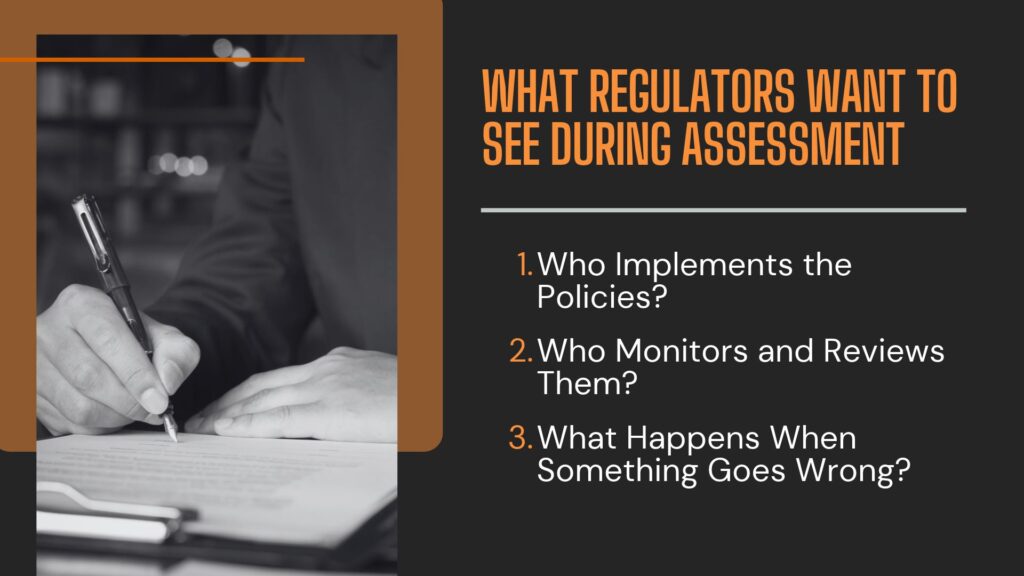
To show that your organisation is ready, you need to demonstrate how your policies guide real decisions and actions. Start by looking at three key areas.
1. Who Implements the Policies?
Your staff need to understand their responsibilities. Each policy should make it clear who takes action, who provides support and who handles any concerns.
For example, if a policy covers incident reporting, staff should know how to report an incident, while managers should understand their role in reviewing it and deciding on the next steps.
Clear responsibilities help everyone understand what they need to do.
2. Who Monitors and Reviews Them?
You also need a way to check that your team follows your policies. This may include regular checks, staff supervision, internal reviews and records that show how your organisation monitors its work.
Don’t wait until an assessment to check if your processes work. Review your policies regularly and update them when your services, staff responsibilities or relevant requirements change.
Management should also know how to spot gaps and take action when something needs attention.
3. What Happens When Something Goes Wrong?
Strong preparation means planning for problems, not just describing the ideal process.
Think about how your organisation handles incidents, complaints, risks and cases where staff don’t follow a policy. Your team should know how to report concerns, who investigates them and how you record the outcome.
You should also be able to show what happens after an issue arises. Do you review the cause? Do you take steps to prevent it from happening again? These actions help demonstrate that your organisation takes its responsibilities seriously.
Connecting Policies to Everyday Operations
Your policies shouldn’t sit apart from the rest of your business. They need to connect with your governance structure, reporting lines and daily work processes.
For example, your aged care policies and procedures should match the way your organisation assigns duties, trains staff, manages risks and records important decisions.
You can check this connection by asking a few practical questions:
- Do staff understand the policies that relate to their roles?
- Do your reporting lines match the responsibilities in your documents?
- Can managers show how they monitor compliance?
- Do your records show that your team follows the required processes?
- Do you review problems and use what you learn to improve your systems?
If your documents say one thing but your team does another, you need to address that gap. Your policies should guide how your organisation operates, not simply help you complete an application.
How to Check If Your Organisation Is Truly Prepared
Before an assessment, take time to review your policies against your actual operations. Don’t just check that every document exists. Check that your team understands and follows the processes you’ve described.
Start with a few simple steps:
- Review your policies: Check that they reflect your current services, staff roles and business processes.
- Talk to your team: Ask staff how they handle tasks and situations covered by key policies.
- Check your records: Look for evidence of training, reporting, reviews and follow-up actions.
- Test your processes: Consider how your team would respond to an incident, complaint or other problem.
- Fix any gaps: Update unclear policies, clarify responsibilities and give staff the guidance they need.
These checks can help you spot issues before an assessment. They also give you a clearer picture of how well your organisation puts its policies into practice.
Preparation Goes Beyond Documentation
Having policies and procedures in aged care is important, but you also need to show how they support your daily operations. Clear responsibilities, regular reviews, staff understanding and proper follow-up all help demonstrate that your organisation takes compliance seriously.
At SAH Consulting, we help aged care providers review their documentation and prepare for assessment. If you’re unsure whether your policies reflect how your organisation actually operates, get in touch with our team. We’ll review them with you and give you a clear view of where you may need to improve.